






Toronto starts construction on landmark co-op housing development
The City of Toronto has announced the start of construction on Canada’s largest co-op housing development in a generation.
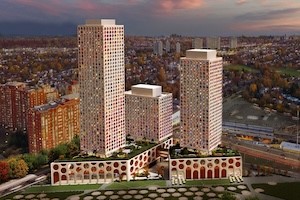 The development, on city-owned land adjacent to Kennedy GO and TTC Station, will deliver a total of 612 new homes including affordable and market rent-controlled co-operative homes.
Funding for the project is provided by the federal government, through the Co-operative Housing Development Program and by the city.
Kennedy Green is being developed through a partnership between the city, CreateTO and the Co-operative Housing Federation of Toronto. The site is formerly a commuter parking lot, and is one of almost 100 city-owned sites that are either housing-ready or may be unlocked for new housing.
The city says the project is a prime example of its commitment to speed up approval times to get more affordable housing built. The project’s application for re-zoning was approved in just 69 days.
“The City of Toronto is breaking ground on Kennedy Green, the largest co-operative housing development in Ontario and one of the largest in Canada,” said Mayor Olivia Chow. “By working closely with key partners, leveraging city-owned land, and investing over $35 million, we approved this project in record-breaking time and are delivering a more caring and affordable city for Torontonians.”
The design team behind Kennedy Green includes Vancouver-based Henriquez Partners Architects and Montreal-based landscape architects CCxA.
With a geothermal energy system, the building will support the City’s climate action objectives and achieve Toronto Green Standard Version 4, Tier 2. Kennedy Green is also being delivered under the One Planet Living Framework – a first for Toronto – to promote sustainable living. The site will also offer 474 square metres of community space as well as 332 square metres of retail space.
This project is contributing to the City’s HousingTO Plan target to deliver 65,000 new rent-controlled homes including 41,000 affordable rental, 6,500 rent-geared-to-income (RGI) and 17,500 rent-controlled homes by 2030.