





Montreal-area port expansion first 'nation-building' project to begin construction
 By Morgan Lowrie
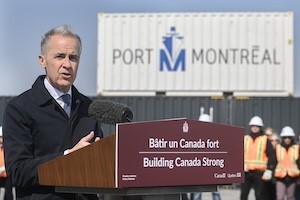
Prime Minister Mark Carney broke ground on Thursday on a long-planned port expansion near Montreal, making it the first so-called nation-building project fast-tracked for approval by the federal government to get off the ground.
Carney was on hand at the building site in Contrecœur, Que., about 45 kilometres northeast of Montreal, to announce the start of work.
Standing against a backdrop of construction equipment and the St. Lawrence River, Carney told reporters the groundbreaking is a sign that Canada is ready to build big projects quickly.
"Contrecœur is about more than the expansion of a port," he said. "It is an example of a confident Canada. A country that is building again, that is connecting to the world."
The port expansion is the first major project, deemed by the federal government to be in the national interest, to begin construction since Carney became prime minister in March 2025. The prime minister said construction on another project, the Mackenzie Valley Highway in the Northwest Territories, would begin this summer.
Carney's government had chosen Contrecœur and a series of other "nation-building" projects to be fast-tracked as a way to strengthen and diversify the economy amid trade uncertainty with the United States.
The Port of Montréal's expansion at Contrecœur was referred in September to the government's major projects office, which helped streamline approvals, develop a financing model and speed up the approval of permits.
Other projects that have been referred to the office include an LNG export terminal and electrical transmission line in northwestern British Columbia, critical minerals mines in several provinces and a hydroelectric project in Iqaluit.
The government says the project is the largest port expansion in Canadian history. It also says the project will increase the Port of Montreal’s capacity by approximately 60 per cent and create thousands of jobs.
The expansion, located in an industrial area on the south shore of the St. Lawrence River, will include integrated rail, road, and marine infrastructure, enabling more goods to ship through the St. Lawrence gateway.
Carney said the port expansion would help boost and diversify trade in a destabilized global economy that is marked by war in the Middle East, Russia’s invasion of Ukraine, and changing trade patterns.
"In the face of that uncertainty, Canada is focused on what we can control," Carney said. "We are building a stronger, more independent, more resilient economy — an economy built on the solid foundation of strong Canadian industries and workers, bolstered by international trade with a diverse set of reliable partners."
He said the project was first proposed 40 years ago and had faced delays ever since.
"For too long, when the federal government examined a new infrastructure project, their immediate question was: “Why?'" Carney said.
"Today, our new government starts by asking: 'How?'"
Ottawa said it provided the Montreal Port Authority with $1.16 billion in financing through the Canada Infrastructure Bank.
Residents and environmentalists have expressed concern about the project, describing it as harmful to the aquatic ecosystem and economically unnecessary. The construction site is in the feeding ground of the copper redhorse, an endangered freshwater fish found only in a few rivers in the St. Lawrence Plain.
Fisheries and Oceans Canada authorized the project in the fall after accepting the Montreal Port Authority's mitigation plan, which includes building a new feeding area for the endangered fish.
Nathalie Pilon, the chair of the Port of Montreal's board of directors, said the expansion is needed, despite a recent decline in overall cargo traffic she attributed in part to U.S. tariffs. She said the port is at around 72 per cent capacity now, and that problems arise when 85 per cent is attained.
“When we look to the future, if we want to double exports to countries other than the United States, we'll run out of capacity fairly quickly,” she said Wednesday in an interview. “And I think that's what we need to make everyone understand. It's a long-term asset for (improving) competitiveness and changing our market access.”
She said the new container terminal would also help Canada to import more goods without passing through the United States.
The Canadian Chamber of Commerce also released a statement praising Thursday’s groundbreaking, which it said “boosts confidence that we can be a more resilient economy and attract the investment we need to continue to build a brighter future for all Canadians.”
Carney said construction on the terminal would begin in earnest this summer, and it should be operational by 2030.
(C) The Canadian Press
With files from Pierre Saint-Arnaud
- Regional
- Economic
- Government
- Projects