






Report: Ontario faced with delivery-capacity crisis
The Vaughan Chamber of Commerce’s 2025 Infrastructure Report warns that Ontario’s infrastructure challenge has evolved from a funding gap into a delivery-capacity crisis.
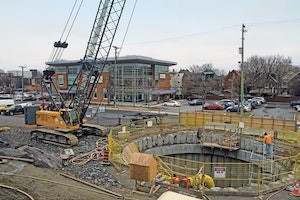 Published annually, the report looks at Ontario’s infrastructure challenge through a delivery lens. It warns that Ontario currently faces approximately $56 billion annually in congestion-related economic and social costs. Without a shift in how projects are approved, tendered, and built, those annual costs are projected to rise to $108 billion by 2044 if congestion levels remain unchanged.
The findings identify "servicing capacity", specifically water and wastewater systems, as the non-negotiable ceiling on housing starts.
As demonstrated by the recent servicing moratorium in Waterloo Region, it says, underinvestment and misaligned sequencing in core infrastructure can result in a pause in housing and employment growth even where planning approvals exist.
The report’s key recommendations include
- Standardize municipal construction specifications across the GTHA to eliminate inefficiency and reduce risk pricing.
- Institutionalize early tendering, with a majority of awards completed by Q4 or early Q1, to protect the construction season and the workforce.
- Shift to parallel permit processing and implement "one-window" visibility into permit status and timelines to reduce sequential delay.
- Re-focus development charges exclusively on core growth-enabling infrastructure and introduce mandatory province-wide transparency standards for development charge background studies.
The report also identifies delivery constraints as a central issue across Ontario’s infrastructure landscape. While it says that provincial initiatives, including recent legislation to streamline approvals and support housing enabling infrastructure, have established progress at the system level, more can be done to algin municipalities on such issues as construction standards, approvals, and development charge administration.
Improved coordination, it says, would support improved delivery capacity and greater consistency in how infrastructure projects move from planning to construction across Ontario.
"The era of performative planning is over. Our data is clear: Ontario is facing a delivery-capacity crisis that is costing us $56 billion today," said Abdus Samad, Vice President of Government Affairs and Strategic Initiatives at the Vaughan Chamber. "We have shovel-ready housing and trade projects stalled by the 'inefficiency incarnate' of fragmented local rules and slow approvals. We need to treat infrastructure as a foundation for competitiveness, not an administrative afterthought."
- Regional
- Economic
- Government
- Projects