






Bruce C Project would add $238B to Canadian economy: report
A new economic impact analysis from the Ontario Chamber of Commerce (OCC) finds that the proposed new Bruce C nuclear project would add more than $217 billion to Ontario’s GDP and $2.3 billion annually to the combined GDPs of Bruce, Grey and Huron counties.
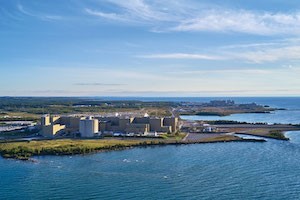 The economic analysis – Bruce C Economic Impact Assessment – Summary of Findings – conducted by the Ontario Chamber of Commerce and Prism Economics and Analysis for the Nuclear Innovation Institute, finds that the Bruce C Project would generate major economic benefits locally, provincially and nationally, driven by both its construction and operating life.
“Ontario’s nuclear advantage is powering our future and showcasing the very best of Canadian technology, resources, and workers,” said Energy Minister Stephen Lecce. “Bruce C represents one of greatest drivers of economic growth in Canada, creating 18,900 jobs and $238 billion lift to Canada’s GDP over its 80-year lifespan. It is clear that Bruce Power’s C is essential to Ontario’s energy and economic future, as we build on-time and on-budget.”
The proposed addition of up to 4,800 megawatts (MW) of energy production through the Bruce C Project would make Bruce Power the largest nuclear generator in the world with a capacity of 12,000 MW. The company is Canada’s largest public-private partnership and its Life-Extension Program and Major Component Replacement Project is the country’s biggest privately financed electricity infrastructure project in Canada.
Of the nearly $238-billion contribution to Canada’s GDP, approximately $61 billion would be generated during the site preparation and construction phase, and more than $176 billion during the operations phase.
“The Bruce C Project would be an investment in strengthening our communities and the economy, while empowering skilled workers and innovation across Ontario,” said Pat Dalzell, Bruce Power’s Vice-President, Corporate Affairs and Market Development. “Bruce Power is committed to creating lasting prosperity while delivering the reliable, carbon‑free electricity and cancer-fighting medical isotopes to power the next century of Canadian innovation and opportunity.”
During the proposed site preparation and construction phase, an estimated annual average total of 18,900 full-time equivalent (FTE) jobs would be created or supported nationally, of which nearly 15,900 jobs would be created or supported in Ontario.
The subsequent operations phase would result in an annual average of over 6,700 FTE jobs nationally, with nearly 5,900 jobs in Ontario. Overall, more than 10,100 total FTE jobs would be created or supported in Canada each year over the project’s entire lifespan, of which approximately 8,700 would be in Ontario.
Aside from employment benefits, tax revenues of $55 million annually for Bruce, Grey and Huron counties would help spawn growth in Bruce Power’s surrounding communities.
“As the host community, we’re proud to work with Bruce Power to advance the Bruce C Project and understand the significant economic impact it would bring,” said Kenneth Craig, Mayor of the Municipality of Kincardine. “Our region has long been a leader in clean energy and this project ensures we remain at the forefront of Canada’s clean-energy future.”
Bruce Power’s current Life-Extension Program and ongoing operations create and sustain 27,000 direct and indirect jobs annually.