






Residential, non-residential contractions drive November permit losses
The total value of building permits issued in Canada in November dropped by $1.8 billion (-13.1%) to reach $12.0 billion, with both the residential and non-residential sectors reporting lower levels of activity for the month.
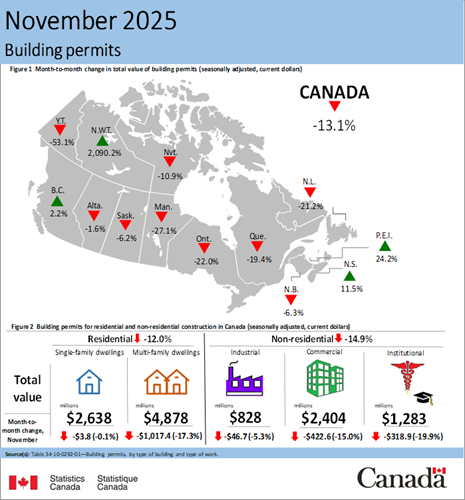 Residential construction intentions decreased by $1.0 billion (-12.0%) to $7.5 billion. Ontario (-$884.5 million) drove this decrease after leading the sector's gains in October.
Overall, the multi-family component fell $1.0 billion to $4.9 billion in November. The national decline was driven by Ontario (-$928.1 million), followed by Quebec (-$263.8 million), while British Columbia (+$196.9 million) tempered the decline.
The single-family component edged down $3.8 million to $2.6 billion in November. Gains in seven provinces and one territory were offset by a decline in Quebec (-$80.5 million).
Nationally, municipalities issued permits for 11.4% fewer dwellings in November compared to October. From December 2024 to November 2025, the total number of multi-family dwellings authorized was 259,300, up from 224,700 compared to the same period 12 months previous.
Meanwhile, the value of non-residential building permits dropped $788.2 million to $4.5 billion, marking a 14.9% decline compared with the previous month. The decline was broad-based; losses were recorded across the commercial (-$422.6 million), institutional (-$318.9 million) and industrial (-$46.7 million) components.
The decrease in the commercial component in November was led by Ontario (-$250.7 million), with the Toronto census metropolitan area (-$233.8 million) contributing the most to the drop. In total, six provinces and two territories showed decreases in the commercial component.
In the institutional component, decreases were observed in nine provinces and two territories in November, with Ontario (-$140.7 million) and Alberta (-$99.4 million) leading the drop.
In November, the decrease in the industrial component was mainly attributed to drops in five provinces and one territory, with Quebec (-$79.0 million), British Columbia (-$41.4 million) and Manitoba (-$39.9 million) leading the decline. Meanwhile, gains in Ontario (+$93.0 million) and the remaining four provinces and two territories tempered the decline in the component.
- Economic
- Government
- Projects
- General Industry