






Provinces, territories announce national energy corridor agreement
Ten of Canada’s 13 provinces and territories have agreed to a partnership to advance new electricity transmission projects and strategic interties across the country.
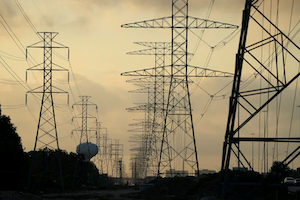
Signing the agreement are Ontario, British Columbia, Alberta, Saskatchewan, Manitoba, New Brunswick, Yukon, Prince Edward Island, Nova Scotia and the Northwest Territories. Quebec has provisionally agreed to the partnership, provided the collaboration is the exclusive jurisdiction of the provinces.
Each region’s respective energy ministers agreed that expanding electricity transmission between jurisdictions is essential to meeting rising demand, strengthening energy security and unlocking the full value of Canada’s energy resources.
Under the agreement, provinces and territories will collaborate to:
- identify and advance new interprovincial and territorial transmission infrastructure, including key intertie projects with elevated speed,
- expand electricity trade within Canada, helping regions meet growing demand and maximize the use of clean, reliable power before exporting abroad,
- advocate for federal support, including investment to accelerate transmission corridors and an electricity strategy that connects Canada east-west and north-south, and
- partner with Indigenous communities in energy development, ensuring meaningful participation and shared economic benefits.
“Ontario has secured a landmark agreement to build an energy corridor that will strengthen our grid using Canadian materials, expertise and workers,” said Ontario Energy Minister Stephen Lecce. “This first-of-its-kind partnership lays the foundation for thousands of jobs, billions in investment, and a modernized grid that advances Canada’s long-term energy future.”
Canada’s grids were built for a different era — designed within provincial borders, rather than a modern economy. According to the North American Electricity Reliability Corporation, several jurisdictions across North America are currently labelled an elevated risk, requiring more power.
Rapid population growth, major industrial expansion, critical mineral development and electrification are driving unprecedented demand for power, while limited interprovincial connections prevent regions from sharing reliable, clean electricity efficiently. Without action, these constraints will lead to higher costs, slower project development, and missed economic opportunities at a time when Canada is looking to strengthen its energy security and global competitiveness.
According to Ontario’s Independent Electricity System Operator, the province’s demand for electricity is forecast to increase potentially as high as 90 per cent by 2050.
Ontario currently operates 14 interties with two neighbouring provinces, three with Manitoba and eleven with Québec, representing a total export transfer capability of about 2,385 megawatts (MW) and a total import transfer capability of about 2,580 MW.
In 2025, Ontario, exported 8.8 terawatt hours of electricity to Quebec.