





Construction costs rise again in Q1 2026
Building construction costs rose again in the first quarter of 2026.
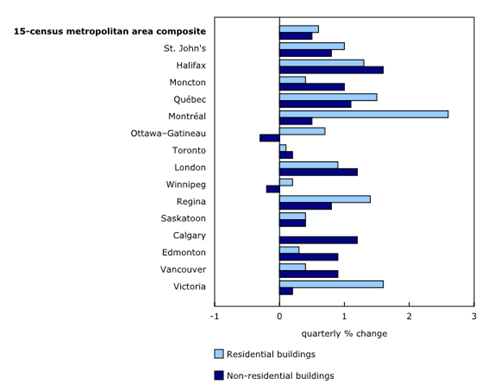 Statistics Canada reports that the costs to build residential structures rose by 0.6% in the first three months of 2026, while non-residential building costs rose by 0.5% over the same period. Both indices reported increases of 0.5% in the fourth quarter of 2025.
Year over year, construction costs for residential buildings rose 2.8% in the 15-census metropolitan area (CMA) composite in the first quarter, while non-residential building construction costs increased 3.6%.
The construction sector encountered challenging conditions in the first quarter, characterized by subdued demand for new projects, ongoing material sourcing constraints, and persistent skilled labour shortages in select trades across the country.
In Ontario, for example, builders noted a decline in bidding and indicated that residential buyers were hesitant to make purchases ahead of the HST rebates, which led to fewer housing starts and delayed developments. Similar comments were echoed across other provinces, as buyers waited for clarity on the expected GST relief for first-time home buyers, which contributed to a slowdown in new projects.
In more active markets such as the Atlantic Region, which saw new construction building permit values increase 16.8% from 2024 to 2025, and the Prairie Region (+14.7%), which saw a similar increase, builders reported skilled labour shortages being their primary market challenge in the first quarter of 2026. At the same time, retaliatory tariffs on steel and steel-related products, introduced in March 2025 and expanded in December, were reported to have contributed to price increases in metal-related products across the country.
Metal fabrications division leads residential construction cost growth
In the first quarter, residential building construction costs rose across all CMAs, with Montréal (+2.6%) reporting the largest quarterly increase, followed by Victoria (+1.6%). Increases were also notable in Québec (+1.5%) and Regina (+1.4%). Winnipeg (+0.2%), Toronto (+0.1%) and Calgary (+0.0%) experienced the smallest growth in residential construction costs this quarter.
At the division level for residential building construction, the conveying equipment division (+2.5%) saw the largest quarterly increase, followed by metal fabrications (+2.1%), plumbing (+1.5%) and structural steel framing (+1.3%). In contrast, concrete (-0.3%), masonry (-1.0%) and fire suppression (-1.3%) recorded price declines in the first quarter.
Construction costs for non-residential buildings increased the most in Halifax (+1.6%) in the first quarter, followed by London (+1.2%) and Calgary (+1.2%). Québec (+1.1%) and Moncton (+1.0%) recorded moderate growth. In contrast, Winnipeg (-0.2%) and Ottawa (-0.3%) were the only CMAs to see price declines.
At the composite level, non-residential building construction costs increased across most divisions measured, with metal fabrications (+2.3%) and structural steel (+1.9%) recording the largest increases. These increases reflect the upward price pressure associated with the implemented retaliatory tariffs. Price pressure across most other divisions remained moderate through the first quarter, while the heating, ventilation and air conditioning (-1.0%) and fire suppression (-7.1%) divisions recorded the only declines.
- Economic
- Projects
- General Industry