






Non-residential gains drive March building permits higher
Strong gains in non-residential construction activity helped drive building permit values higher in March 2026.
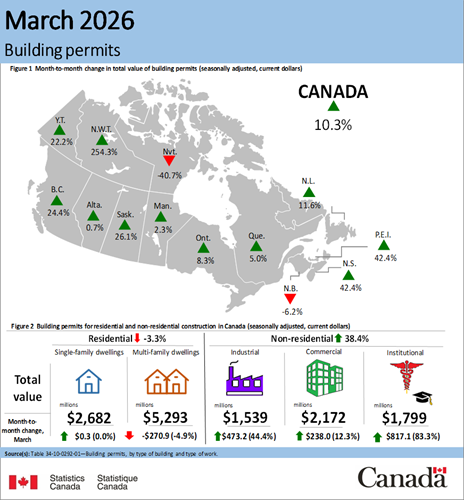 Statistics Canada reports that the total value of building permits issued in Canada rose by $1.3 billion (+10.3%) to reach $13.5 billion for the month. A gain of $1.5 billion in non-residential permit values more than offset a decline of just under $271 million in residential building activity.
The increase in the non-residential sector was led by the institutional component (+$817.1 million to $1.8 billion). Growth in British Columbia (+$665.5 million) and in the Vancouver area in particular, led the way.
A rise of $73 million in the industrial component was mostly attributable to Ontario (+$510.8 million) and supported by Quebec (+$113.6 million), while seven provinces and two territories contributed to the increase in the commercial component (+$238.0 million).
Conversely, residential construction intentions decreased by 3.3% for the month. The decline was driven by the multi-family component, which fell $270.9 million to $5.3 billion. The single-family component saw virtually no change month over month and remained at $2.7 billion.
The decline in the multi-family component in March was driven by Ontario (-$393.1 million) and Quebec (-$163.5 million). Meanwhile, gains in British Columbia (+$90.7 million), Nova Scotia (+$83.8 million) and four other provinces and one territory tempered the decline.
In the single-family component, a large decline in Alberta (-$65.9 million) in March was offset by increases in Ontario (+$33.2 million), Saskatchewan (+$22.9 million) and British Columbia (+$19.4 million), leading to stagnant construction intentions in March.
Residential sector leads Q1 increases
In the first quarter of 2026, the total value of building permits increased $445.7 million to $39.0 billion, up 1.1% from the previous quarter.
The residential sector grew $514.5 million (+2.4%) to $22.2 billion in the first quarter. The single-family component increased $349.8 million to $7.4 billion after four consecutive quarterly declines. Gains in single-family construction intentions were driven by Ontario (+$142.8 million) and Quebec (+$110.6 million).
Multi-family construction intentions were up $164.7 million to $14.6 billion in the first quarter, with Ontario (+$392.3 million) and Quebec (+$186.1 million) leading the increase. Alberta (-$548.0 million) moderated the gains.
Nationwide, municipalities approved construction of a total of 68,500 single-family and multi-family units in the first quarter, down from the 71,000 units authorized during the same period one year earlier.
Non-residential construction intentions decreased $347.4 million to $13.4 billion in the first quarter. The commercial component fell $813.7 million to $5.8 billion, marking the largest quarterly decline since the fourth quarter of 2020. The decline recorded in the first quarter of 2026 was supported by the institutional component (-$403.9 million). Meanwhile, the industrial component (+$870.2 million) tempered declines.
- Regional
- Economic
- Projects
- General Industry